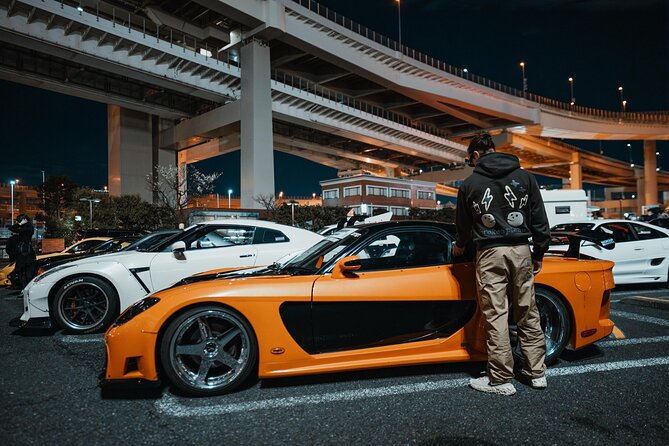
Every night in Tokyo, somewhere between Shibuya and Yokohama, a convoy forms that looks suspiciously like a film set: an R34 Skyline in Bayside Blue, a Lancer Evolution with rally-car aero, a Bumblebee Camaro, a Silvia with more wing than roof. It's the daikoku fast and furious drift experience — the most-booked format on the official Daikoku listings, with 4,754 reviews averaging 4.8 stars — and it exists because Tokyo Drift turned a Yokohama truck stop into a pilgrimage site. This guide covers what the night includes, what's genuinely movie-accurate, and where Hollywood ends and Japanese law begins.
Quick summary
| Item | Detail |
|---|---|
| Price | from $121 pp; cars seat 3–4 (per the GetYourGuide listing) |
| Rating | 4.8★ from 4,754 reviews; the location's top pick |
| Convoy size | 10–50 cars nightly from a 30–40 car fleet |
| Route | Wangan/C1 → tunnels → Rainbow Bridge → Daikoku PA → A-PIT Autobacs → Tokyo Tower |
| Runs | Every day; late "Midnight Run" option (15+ only) |
| Real drifting? | No — legal cruising; the meet is the show |
The fleet: what you might actually ride in
The headline operator runs a rotating fleet of 30–40 tuned cars, and the listing reads like a game-garage save file: Brian's-style Skyline R34, GT-R R34 and GT-T, R35 GT-Rs including a 700 HP Nismo build and a black carbon car, Lancer Evolution 7 and 10, Civic Type R, Subaru STIs, a Chaser drift car, Silvia S14 and S15, a Liberty Walk "Red Hot Devil" R35, a lightning-McQueen-liveried RX-8, widebody BMW M3s, and a Camaro Bumblebee for the crossover fans. Three to four guests share each car, and the convoy on any given night runs from 10 to 50 cars — a rolling spectacle that draws phone cameras at every traffic light.
The route: Tokyo Drift's real locations, in one loop
- Meet the convoy. Meeting point per your ticket (Odaiba's Aomi parking is a common start). Arrive 15 minutes early — the listing warns delays over 15 minutes can cost your seat, though operators state a "never leave anyone behind" policy if you message them.
- Tunnels and the C1. The neon-striped expressway tunnels are the film's visual signature, and the convoy threads them in formation — the moment most GoPros come out.
- Rainbow Bridge. Tokyo Bay, lit skyline, forty tuned cars crossing in sequence. Legal speed, cinematic everything else.
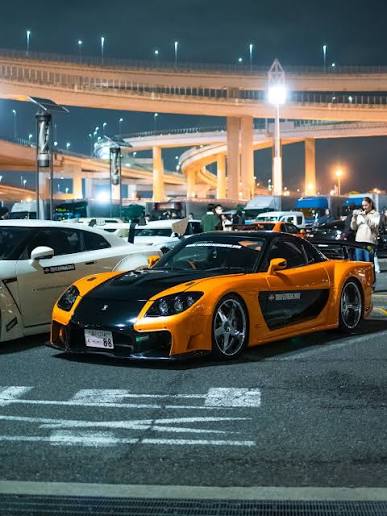
- Daikoku PA. The parking lot from a thousand YouTube thumbnails. An hour-plus among whatever Japan's scene brought tonight — often including a Veilside FD RX-7 in Han's colours. Full ground rules in the experience guide.
- A-PIT Autobacs + Tokyo Tower. Parts-store shopping and the landmark photo stop close the loop. The Midnight Run variant skips both for more expressway time.
Movie vs reality: an honest scorecard
| From the film | On the tour |
|---|---|
| Han's orange Veilside RX-7 | Genuine Veilside-kitted tributes appear at Daikoku regularly; some fleets run rotary builds |
| Shibuya crossing scenes | Several tours route past Shibuya; the crossing is real and unchanged |
| Parking-garage drift battles | Fiction — filmed largely on LA sets. Nothing drifts in a Japanese parking structure |
| Street racing culture | Historical truth, present-day fiction: the 90s Wangan era ended with policing; today's scene is meets and legal cruising |
| The car-meet energy | Completely real — arguably better than the film, because nobody staged it |
That last row is the honest sales pitch. The film compressed and Hollywood-ised a culture, but the culture itself — the builds, the crews, the parking-lot society at midnight — is exactly where the movie found it. You're not visiting a tribute act; you're visiting the source material.
Standard tour or Midnight Run?
The standard evening slots include the sightseeing arc (Autobacs, Tokyo Tower) and take kids; they're the right default for most visitors and the only choice for families. The Midnight Run (22:00+, age 15+) trades sightseeing for emptier expressways and a rawer, longer cruise — the version for people who care more about the drive than the stops. Both spend the same core time at Daikoku. Saturday standard slots sell out first; the Midnight Run is the connoisseur's Tuesday booking. Full timing logic in the schedule guide.
Is it worth $121?
Against the other Daikoku formats, the Fast & Furious convoy costs $16 more than the insider JDM tour and delivers a different product: scale. No other format puts you inside a 30-plus-car rolling meet, and no other format's reviews lean so heavily on the word "unreal". Choose it if the convoy fantasy is the point. Choose the insider scene tour if you want conversation and context over spectacle, or a club night if you want members' personal builds. All three end at the same glowing parking lot — the choice is about the two hours before it.
Fast & Furious drift — FAQ
Is there actual drifting on the tour?
Can I request Han's RX-7 or Brian's Skyline?
How many people per car?
Does the tour run every night?
Is it suitable for children?
What should I bring?
The daikoku fast and furious drift experience is fan service done by the actual scene: real tuned cars, real locations, and a parking lot that needs no set dressing. Book a dry night, skip the car-request stress, and let the convoy do what it does every single evening — turn a Yokohama truck stop into the best third-act location in Tokyo.