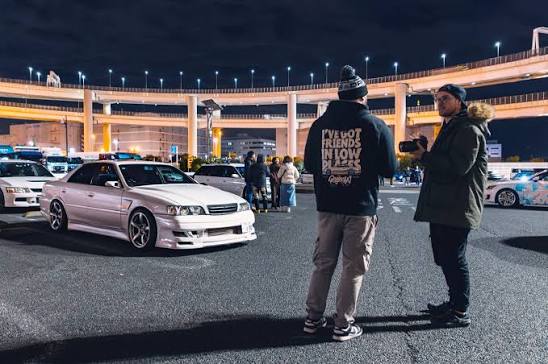
"Daikoku Futo" (大黒ふ頭 — Daikoku Pier) is the name of the man-made island the parking area sits on, and among enthusiasts it's shorthand for the scene itself. When people search for the daikoku futo tuning club, they're usually picturing one organised group that runs the meet. The reality is better: Daikoku is a commons. Nobody owns Tuesday night. Instead, dozens of independent crews — some decades old, some three friends with matching Chasers — treat the island as neutral home ground. Understanding that structure is the key to understanding why the place feels alive in a way organised car shows never do.
Quick summary
| Question | Answer |
|---|---|
| Is there one official club? | No — dozens of independent crews share the ground |
| Can visitors ride along? | Yes — club-run convoy tours from ≈ $99–157 pp (per GetYourGuide) |
| Club nights peak | Friday & Saturday 20:00–24:00; Sunday morning for classics |
| Typical club cars | R34/R33 Skylines, JZX Chasers, Silvias, Evos, WRX STIs, Supras |
| Booking window | 3–7 days; ~1 week to request a specific member car |
Who actually fills the lot: a field guide to Daikoku crews
Walk the rows on a busy night and you're reading a map of Japanese tuning subcultures, each with its own crews, codes and aesthetics:
- Expressway cruising clubs. The spiritual heirs of the Wangan runners — organised crews of Skylines, Supras and GT-Rs who cruise the Bayshore Route in convoy and use Daikoku as their pit stop. Several now run the bookable tours visitors join.
- Drift-style street crews. JZX90/100 Chasers, Silvias, Laurels — big angle kits, missile-car scars, tandem stickers. They drift at circuits like Ebisu and Nikko; Daikoku is where they park and talk.
- Kaido racers & kyusha circles. The wildest visual culture in the lot: 1970s–80s classics with metre-long splitters, takeyari exhaust pipes and paint schemes borrowed from Group 5 racing. Often out on Sunday mornings.
- VIP (bippu) style crews. Big Toyota Celsiors and Nissan Cimas slammed on aggressive fitment, immaculate interiors. Quiet, meticulous, and possibly the most Japanese subculture of them all.
- Itasha teams. Cars fully wrapped in anime livery, frequently NSXs and RX-7s worth serious money underneath. The overlap of otaku and tuner culture, and a Daikoku signature.
- One-make clubs. Roadster (MX-5) circles, kei-car crews, S2000 clubs, air-cooled Porsche groups, Italian exotics — everyone's welcome on the island, and everyone shows up eventually.
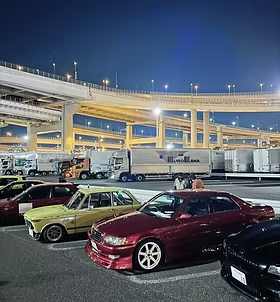
How club culture works (and why it's so orderly)
Japanese car crews run on the same social physics as the rest of the country: seniority, respect, and immaculate presentation. Cars arrive together and park together — row position is social information. Builds are maintained obsessively; a club car with a dirty engine bay embarrasses the whole crew. Noise is calibrated: engines get revved for people who ask nicely, not as background chaos, because every crew knows that one out-of-control night gets the PA closed for all of them. That self-policing is why a lot full of 500-horsepower street cars stays calmer than most European supermarket meets — and why police tolerate the gathering at all.
The other thing to understand: crews welcome genuine interest. The stereotype of a closed, suspicious scene is decades out of date. Members photograph each other's cars, trade parts gossip, and — increasingly — host paying visitors, having realised that the world's fascination with their Tuesday routine is itself valuable.
Riding with a club: how the bookable convoy nights work
Several established crews have turned their regular runs into bookable experiences on GetYourGuide — the listings describe themselves openly as clubs of enthusiast drivers whose members drive their own personal builds. The format, per the official listings:
- Meet the convoy in Tokyo (Akihabara and Shibuya are common start points). Your seat is in a member's own car — fleets listed include a Bayside Blue R34 with Z-tune kit, Varis-kitted Evo IX, Evo VIII, Mk5 Supra, three generations of WRX STI and a Civic Type R.
- Run the classic route as part of the club: C1 loop, Wangan, Rainbow Bridge, then into Daikoku Futo — arriving inside a convoy, not stepping off a tour bus.
- Switch cars between stops. On multi-car nights, several clubs rotate guests between builds at each stop — the closest thing to test-driving a subculture.
- Finish with drop-off — late departures typically include free drop-off across Tokyo's 23 wards.
Can you actually join a Daikoku tuning club?
As a visitor — no, and it's worth being straight about that. Membership means owning a build, showing up weekly, and carrying the crew's reputation on your rear bumper; it isn't sold. What is open to you: riding as a club guest for a night (above), turning up repeatedly if you live in Japan and letting familiarity do its slow work, or supporting crews through their merch and socials. Some clubs frame their tour fee explicitly as a temporary community membership covering the meet access and guiding — an honest description of what you're buying: one night inside the fabric, not a patch on a jacket.
Spotting the difference: club night vs regular tour
Both formats visit the same island, but they read differently once you know what to look for. A regular tour drops you at the meet as an observer with a great guide. A club night makes you briefly part of the exhibit — you arrive in the convoy people photograph, your driver greets half the lot by name, and conversations start with the car you stepped out of. If your budget covers either, choose by temperament: photographers often prefer the free-roaming anonymity of a standard tour (see the JDM scene tour guide), while enthusiasts who want stories and engine-bay tours pick the club night every time. Compare all tiers in the fees & prices breakdown.
Daikoku Futo tuning club — FAQ
Is there an official Daikoku Futo tuning club I can contact?
How much does a club convoy night cost?
Can I choose which club car I ride in?
Do the clubs speak English?
Are these clubs legal? Is this street racing?
When do the most clubs show up?
The daikoku futo tuning club isn't an organisation you can find — it's an ecosystem you can visit. Learn the crews' visual languages, respect the etiquette, and if you want the full-fat version, book a night where the convoy you arrive in is the club. That's as inside as Japan's car culture gets without buying a Chaser.