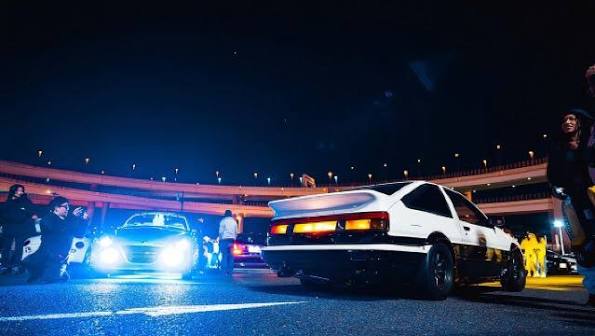
The daikoku pa experience starts before you see a single car. Your driver merges onto the Bayshore Route, the industrial dark of Yokohama's port slides past, and then the expressway coils down through a four-level spiral of ramps onto an island — and at the bottom of that spiral sits a parking lot glowing sodium-orange, already rumbling. Nobody organised tonight. Nobody sold tickets. The meet simply happens, the way it has for over 30 years.
Quick summary
| Question | Answer |
|---|---|
| What it is | Japan's biggest informal car meet, at a Shuto Expressway rest area |
| Cost | PA entry free; tours from ≈ $92–157 pp (per GetYourGuide) |
| Time at the meet | 60–90 min within a 3–4 h tour |
| Best nights | Dry Friday & Saturday, 20:00–24:00 |
| Booking | 3–7 days ahead; free cancellation on most listings |
| Access | Vehicle only — no walking in; see how to get there |
Walking the rows: what you'll actually see
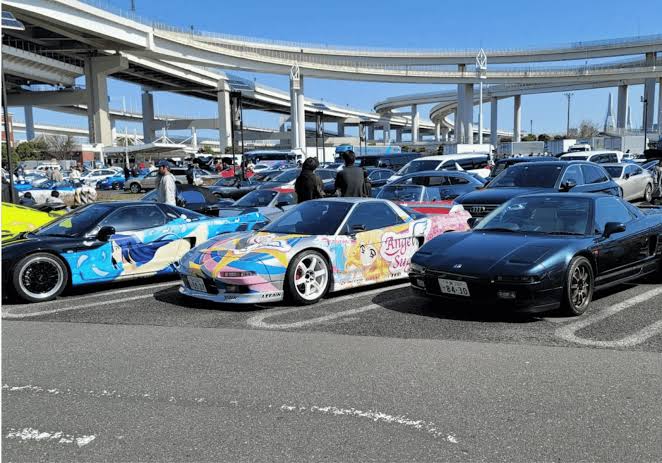
Daikoku's magic is randomness with a high floor. On a given Saturday the front rows might hold a Liberty Walk GT-R next to a bosozoku-styled kaido racer with a two-metre exhaust, an itasha NSX wrapped in anime livery, three generations of Skyline parked in sequence, and a delivery-spec kei van whose owner installed a full aero kit anyway. Twenty metres away: Lamborghinis. Behind them: American muscle, lowrider Cadillacs on hydraulics, or a perfectly restored Toyota 2000GT. The lineup resets nightly, which is why regulars keep coming after decades — and why reviewers on the official listing (4.8★ across 13,700+ reviews) so often write "no two visits are the same".
Structure your walk like the locals: one slow full lap first, no photos, just seeing what came tonight. Then a second lap for the cars that stopped you. Engines fire at random — a 2JZ spooling somewhere behind you is the meet's soundtrack — and when a famous build rolls in, the crowd migrates toward it like iron filings.
The unwritten rules (that everyone expects you to know)
- Don't touch the cars. Not the wing, not "just the mirror". Leaning on a car for a selfie is the fastest way to sour the whole row.
- Ask before photographing people. Cars are fair game by convention; faces aren't. A gesture at your camera plus "OK?" works in any language.
- Stay out of driving lanes. The lot is live — cars arrive and leave constantly, some with very little ground clearance and very poor visibility.
- Keep plate close-ups out of your posts. Owners tolerate photography partly because plates usually get blurred. Return the courtesy.
- Noise happens; don't beg for it. Rev battles invite police attention, and police attention closes the PA for everyone. Guides will say the same thing on the drive in.
- Talk to owners. This is the underrated half of the experience. Many speak some English, most respond to genuine interest, and a good guide will translate. Compliment the build, ask what's under the hood, and you'll learn more in ten minutes than a year of forums.
Food, facilities and the fried-chicken ritual
The rest-stop building is gloriously ordinary: a food counter serving ramen, curry rice and karaage (the fried chicken has minor cult status among regulars), rows of vending machines with hot coffee in winter, clean toilets, and a small konbini-style shop. Budget ¥500–1,500 and pay in cash to be safe. Eating cheap noodles at a plastic table while a $200,000 supercar idles ten metres away is exactly the high-low contrast that makes the daikoku pa experience feel so Japanese. Facilities are open to everyone — no purchase required, no VIP area, no shortcuts to buy. That flat sociality is part of the culture: at Daikoku, a student's Silvia and a collector's F40 park in the same rows.
Photography: getting the shot without becoming the problem
The junction's illuminated concrete loops are the signature backdrop — shoot rows against them from the lot's outer edge. Blue hour (arrive 19:30–20:30) gives you sky detail; after 22:00 you're working sodium and LED light, which suits the mood better anyway. Phones do fine; if you bring a camera, a fast 35mm equivalent covers 90% of shots. Tripods are tolerated at quiet times, awkward on packed Saturdays. The one hard rule repeats from above: never step into a driving lane for an angle. For a dedicated photo night, a dry Tuesday or Wednesday around 22:00 gives you clean rows and patient owners — more on timing in the schedule guide.
How to get there (and why "just take a taxi" disappoints)
Daikoku PA sits on Daikoku Pier at 15 Daikokufutō, Tsurumi Ward, Yokohama — inside an expressway junction, on an island, with no pedestrian access. No train goes there; the nearest stations are kilometres away across truck-port roads you're not allowed to walk along. Your real options:
- Guided tour (what most visitors do). Pickup in central Tokyo, expressway cruise in a tuned car or van, guide handles everything. From ≈ $92 pp; see the price breakdown.
- Drive yourself. Rental car plus Shuto Expressway tolls. Doable, but you'll arrive without context, park among builds that make rentals look apologetic, and miss the convoy element. Note: leaving and re-entering the expressway costs a new toll.
- Taxi. Technically possible, practically poor: the round trip with waiting time from Tokyo usually exceeds a shared tour seat, and the driver waits with the meter running.
Who this experience fits (and who should skip it)
Book it if you've ever cared about JDM cars, played a Gran Turismo or watched anything with drifting in it; if you're a photographer hunting a subject Tokyo doesn't otherwise offer; or if you want one night in Japan that isn't temples and food halls. Non-enthusiast partners consistently rate it higher than expected — the spectacle carries itself. Skip it if you need guarantees: this is live culture, not a museum. A rainy Tuesday delivers a fraction of a dry Saturday, and nobody refunds the weather. If your trip allows one flexible evening, spend it here; if your only free night is a typhoon, spend it elsewhere and keep the free cancellation.
Daikoku PA experience — FAQ
Is the Daikoku PA experience worth it for non-car people?
Can I touch or sit in the cars?
Is it safe? Is it legal?
How much time do I get at the meet?
What should I wear or bring?
What if the meet is empty on my night?
The daikoku pa experience is the rare tourist activity that isn't staged for tourists — you're visiting something that would happen identically without you. That's exactly why it sticks. Pick a dry weekend night, book the seat, learn the two rules that matter (hands off, ask first), and go watch Japan's car culture happen in its natural habitat.